

If you’re building a garden room, garden office or home workspace, you’ve probably already thought about how you’ll heat it, light it and power your equipment.
But there’s another option worth considering: plug-in solar for Garden Rooms.
Plug-in solar systems are a relatively simple way of adding a small solar installation without going down the route of a large traditional rooftop solar system.
For a garden room, they could be an interesting option for generating some of your own electricity and reducing the amount of power you need to take from the grid.
In this guide, we’ll explain what plug-in solar is, how it can work alongside a garden room, where the panels could be installed and what you should consider before buying a system.
What is plug-in solar?
Plug-in solar is a type of small-scale solar generation system designed to connect to a property’s electrical system through a suitable connection.
Instead of installing a large conventional solar PV system, plug-in systems are generally designed around a smaller number of solar panels and a microinverter.
A typical system might consist of:
- Solar panels
- A microinverter
- Mounting equipment
- AC connection equipment
- Monitoring equipment
The solar panels generate DC electricity from sunlight. The microinverter converts this into AC electricity that can be used by the property’s electrical system.
Some systems can be monitored using a smartphone app, allowing you to see how much electricity your panels are generating.
Could plug-in solar work with a garden room?
Potentially, yes.
A garden room can be an interesting application for a small solar system because it often has its own regular electricity demand.
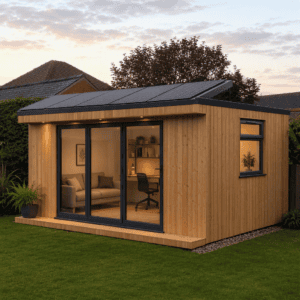
A garden office might use electricity for:
- A computer
- One or more monitors
- Lighting
- Wi-Fi equipment
- Phone and laptop charging
- Heating
- Air conditioning
- Printers and other office equipment
A garden gym, studio or entertainment room could have different requirements.
The important thing to remember is that solar generation varies throughout the day.
The panels may be producing electricity while you’re using your garden room, but they won’t generate the same amount continuously.
Plug-in solar should therefore generally be thought of as a way of generating some of your electricity, rather than automatically making your garden room completely self-sufficient.
Where can you install the solar panels?
The garden room roof is the obvious location, but it isn’t necessarily the only option.
Garden room roof
If the roof is suitable, solar panels can potentially be installed directly on the garden room.
This can be a particularly neat solution because the panels are already close to the building where the electricity is being used.
However, the roof structure and mounting system need to be suitable for the installation.
If you’re building the garden room from scratch, it’s worth considering solar before construction begins.
Flat garden room roof
Flat-roof garden rooms can potentially provide a useful area for solar panels.
A suitable mounting system can allow the panels to be positioned at an appropriate angle and orientation.
However, the mounting system needs to be compatible with the roof construction and weather conditions.
Don’t assume that any solar panel mounting system can simply be placed on a garden-room roof.
Ground mounted
Another option is to install the panels somewhere else in the garden.
This can make sense if the garden-room roof is shaded or doesn’t provide enough suitable space.
The disadvantage is that the panels take up garden space and need to be positioned carefully to minimise shading.
Another outbuilding
If you have a garage, shed or other suitable outbuilding, this could potentially provide another location for the panels.
The best location will depend on sunlight, available space, shading and the practicalities of connecting the system.
How much electricity can plug-in solar generate?
This depends on the size and orientation of the panels, shading, weather, location and time of year.
A system rated at 800W or 900W doesn’t produce that amount of electricity continuously.
The rated figure is the maximum output under appropriate conditions.
On a bright summer day, a small solar system could generate useful amounts of electricity.
On a short, cloudy winter day, generation can be much lower.
This is why it’s better to think about solar generation over a day, month or year rather than simply looking at the maximum wattage printed on the panels.
What does the wattage actually mean?
You’ll often see solar kits described using figures such as:
800W
900W
920W
These figures can be confusing because there can be more than one wattage figure associated with a solar system.
For example, the panels might have a combined rated capacity of 920Wp, while the microinverter might have a maximum AC output of 800VA.
These aren’t necessarily contradictory.
The solar panels can have a higher combined capacity than the inverter’s maximum output.
This is known as oversizing the PV array, and it can help the inverter reach a useful output for more of the day when conditions aren’t perfect.
When comparing systems, look at the panel capacity and the inverter output rather than comparing one wattage number in isolation.
Do you need a battery?
Not necessarily.
A battery can be useful, but it adds cost and complexity to the system.
Without a battery, electricity generated by the solar panels can be used by your property when it is being generated.
If your garden room is being used during the day, this can be useful because your computer, lighting and other equipment may be consuming electricity while the panels are generating it.
With a battery, some surplus generation can potentially be stored for later use.
For example:
Daytime
Solar panels generate electricity → garden room uses some → surplus can charge the battery.
Evening
Solar generation falls → stored electricity can be used.
Whether a battery is worthwhile depends on how much electricity you use, when you use it and the additional cost of the battery system.
For a small garden office, it may not be necessary.
Is plug-in solar suitable for a DIY garden room?
This is one of the reasons plug-in solar is interesting to DIY garden-room builders.
You don’t necessarily need to design a large solar PV system into the building.
A smaller system can potentially be added once the garden room has been completed, provided the installation meets the relevant requirements.
However, DIY garden room doesn’t automatically mean DIY electrical installation.
Solar generation equipment involves electricity and should be installed and connected in accordance with the applicable requirements.
Always follow the manufacturer’s instructions and use a suitably qualified person where required.
Is plug-in solar legal in the UK?
This is an area where you should be particularly careful when researching products.
Not every small solar kit sold online should automatically be assumed to be suitable for connection to a UK electrical installation.
The relevant requirements and compliant products can change, so you should always check the current status of the specific system you are considering.
In particular, look for evidence that the complete system is suitable for the intended UK connection and that the inverter and system configuration meet the applicable requirements.
Don’t simply rely on a product being advertised as “plug-in solar” or “balcony solar”.
What is ENA compliance?
You may come across the term ENA when researching plug-in solar systems in the UK.
The Energy Networks Association maintains the relevant connection information for generation equipment.
If you’re considering a plug-in solar system, check the current ENA Connect Direct information for the specific equipment or system rather than assuming that all products are equivalent.
This is particularly important because the plug-in solar market is developing quickly and new products are appearing.
Always check the current information before purchasing.
What should you look for when buying plug-in solar?
There are several things worth comparing.
1. Solar panel capacity
Look at the total rated output of the panels.
A system with two 460W panels, for example, has a combined panel capacity of 920Wp.
2. Microinverter output
The inverter determines how much AC power the system can deliver.
Don’t compare kits solely on the total panel wattage.
3. Panel efficiency and quality
Solar panels are available with different cell technologies and efficiency ratings.
Look at the manufacturer’s warranty and performance guarantees as well as the headline wattage.
4. Mounting system
Don’t overlook the mounting equipment.
A good solar panel is only part of the system.
If you’re installing panels on a garden-room roof, the mounting system needs to be suitable for the roof construction.
5. Cable length
Check how far the panels will be from the intended connection point.
Some kits include a standard-length cable, while longer cable options may be available.
6. Monitoring
Many modern microinverters allow you to monitor solar production using an app.
This is useful because you can see whether the system is actually generating as expected.
7. Warranty
Compare the warranties for:
- Solar panels
- Microinverter
- Mounting equipment
- Other components
Don’t just look at the panel warranty.
8. Supplier support
This is particularly important with newer types of solar products.
A cheap kit isn’t necessarily a bargain if you can’t get help when something goes wrong.
Look for an established supplier with clear contact details, product documentation and a straightforward warranty process.
Can plug-in solar power a garden room without mains electricity?
This is where things can get confusing.
A plug-in solar system connected to a property’s electrical system is different from an off-grid solar system.
If you want a garden room that doesn’t have a connection to the mains at all, you’ll normally need a different type of system involving equipment such as:
- Solar panels
- Batteries
- An inverter/charger
- Appropriate protection and control equipment
An off-grid system needs to be designed around the electricity requirements of the building.
That’s a very different proposition from simply adding a small plug-in solar system to a garden room that already has a mains electrical supply.
Could solar reduce the running cost of a garden office?
Potentially.
If your solar panels generate electricity that is used by your garden room, that electricity doesn’t need to be purchased from the grid at that moment.
The potential benefit depends on:
- How much electricity the system generates
- How much electricity the garden room uses
- When the garden room is occupied
- Your electricity tariff
- The cost of the solar system
- Whether you have battery storage
Heating is particularly important.
A computer and a couple of monitors might consume relatively little electricity compared with an electric heater or air-conditioning unit.
If you’re planning your garden room around solar, it’s therefore worth considering the building’s heating and cooling requirements as part of the overall design.
Is plug-in solar worth considering for a garden room?
For some garden-room owners, it could be.
It’s particularly worth investigating if:
- Your garden room gets plenty of sunlight
- You use it regularly during the day
- You want to generate some of your own electricity
- You don’t need a large whole-house solar installation
- You have a suitable roof or another location for the panels
- You’re interested in adding solar without installing a large conventional system
It may be less attractive if your garden room is heavily shaded, rarely used or has very low electricity consumption.
And if you’re planning a much larger solar installation, a conventional professionally designed system may make more sense.
Plug-in solar vs traditional solar
The two approaches aren’t necessarily competing products.
Plug-in solar
Generally more suited to smaller systems and people looking for a relatively simple way to add solar generation.
Potential advantages:
- Smaller installation
- Lower initial cost
- Suitable for smaller electricity requirements
- Can be interesting for garden rooms and outbuildings
- Some systems include simple monitoring
Potential disadvantages:
- Smaller generation capacity
- May not be suitable for every property
- Less suitable for high electricity demand
- Product and regulatory requirements need careful checking
Traditional solar PV
A conventional solar installation is generally designed as a complete system for the property.
Potential advantages:
- Larger systems are possible
- Can be combined with substantial battery storage
- Suitable for higher electricity consumption
- Can potentially serve the whole property
Potential disadvantages:
- Higher initial cost
- More involved installation
- Usually requires professional design and installation
- May be unnecessary for a small garden room
Planning solar into a new garden room
If you’re building a garden room yourself, the best time to think about solar is before you build it.
Even if you aren’t ready to install panels immediately, consider:
Roof structure
Make sure the roof design can accommodate your intended installation.
Roof space
Think about where panels could be positioned.
Avoid placing rooflights or other features where they unnecessarily restrict future panel placement.
Shading
Look at the position of trees, fences and buildings.
Remember that trees can grow substantially over the lifetime of your garden room.
Cable routes
Consider how solar cables could enter the building and where equipment could be located.
Electrical design
Think about your expected electricity consumption and whether you might want battery storage in the future.
A little planning at the beginning can make a future solar installation considerably easier.
Plug-In Solar Kits for Garden Rooms
The UK plug-in solar market is developing quickly, and there are now a growing number of systems aimed at people looking for smaller-scale solar generation.
We’re keeping an eye on the available options and will be comparing systems based on things such as:
- Solar panel capacity
- Microinverter output
- Panel quality
- Mounting options
- Warranty
- Monitoring
- Price
- Supplier support
- Current UK compliance
Rather than choosing a system simply because it has the highest wattage, it’s worth looking at the complete package and considering how well it suits your garden room.
Our advice
If you’re already planning a garden room, solar is worth thinking about even if you don’t install it immediately.
The roof design, orientation, available space and electrical layout can all influence your options later.
And if you’re considering plug-in solar, don’t simply buy the cheapest kit you can find.
Check the complete system, the inverter, the mounting equipment, warranties, supplier support and, importantly, the current UK requirements for the particular product.
The technology and the market are developing quickly, so information that was correct a year ago may not necessarily apply to products available today.
Building your own garden room?
If you’re at the planning stage, take a look at our DIY garden room plans.
Our plans are designed to give you a detailed starting point for building your own garden room, with drawings, dimensions, materials information and other resources to help you plan your project.


